
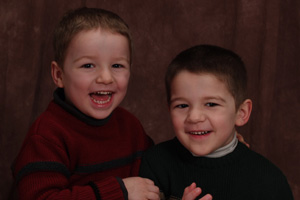
 After a couple of months trying to figure out why one of our five-month old fraternal twin sons, George, hated tummy time, had a purple abdomen and was getting paler and paler, he finally lapsed into unconsciousness on December 16, 2005. Upon rushing him to the hospital, it was for many hours unclear what was wrong. One thing was clear; George’s hemoglobin, which carries oxygen in the blood, was at 4. Normal is between 11.5 and 15.5. Many hours later, George received a transfusion which kept him alive. Experimental equipment finally imaged a tumor and he was scheduled for exploratory surgery the next day. During the five plus hour surgery it was found that he had a bleeding tumor the size of a grapefruit attached to the renal artery behind his liver, (which is why it could not be easily found by casual examination). Much of the tumor was removed at this time.
Turned out that George was one of about 400 children a year who get neuroblastoma, an extremely rare form of cancer, and his was the worst possible category–Stage 4S. His prognosis was a reasonable chance of survival since it was caught early, assuming that it did not migrate elsewhere into the body and it did not grow back. It did both.
Three surgeries and eight rounds of chemotherapy over the next year and a half eliminated the main tumor and the tumor material that had moved into his bone marrow and blood. In one of the surgeries, he lost his right kidney and will be on transplant alert his entire life. George was born with this cancer, and he is still nowhere near cured, but his prognosis is now good. He handled a lot in his early life, spending over 100 of his first 400 days in various hospitals and coming out with a strong, vibrant and cheerful personality that makes him our hero. We hope that his cancer will remain in remission, and if it does, he should be clear of danger from this disease by the time he is six.
Days after he was declared to be in remission, his twin brother Thomas was found to be autistic. We are now working through his therapies, which may be ongoing for life. He now receives daily speech, occupational, developmental and physical therapy as well as several medications. Both have required round the clock care since George first fell ill, so Dad has become the caregiver due to Mom’s better health plan. They are both brilliant, beautiful boys and we do whatever we can to get them both to a point where they can hopefully become happy, productive, healthy individuals with as bright a future as possible.